Events Calendar
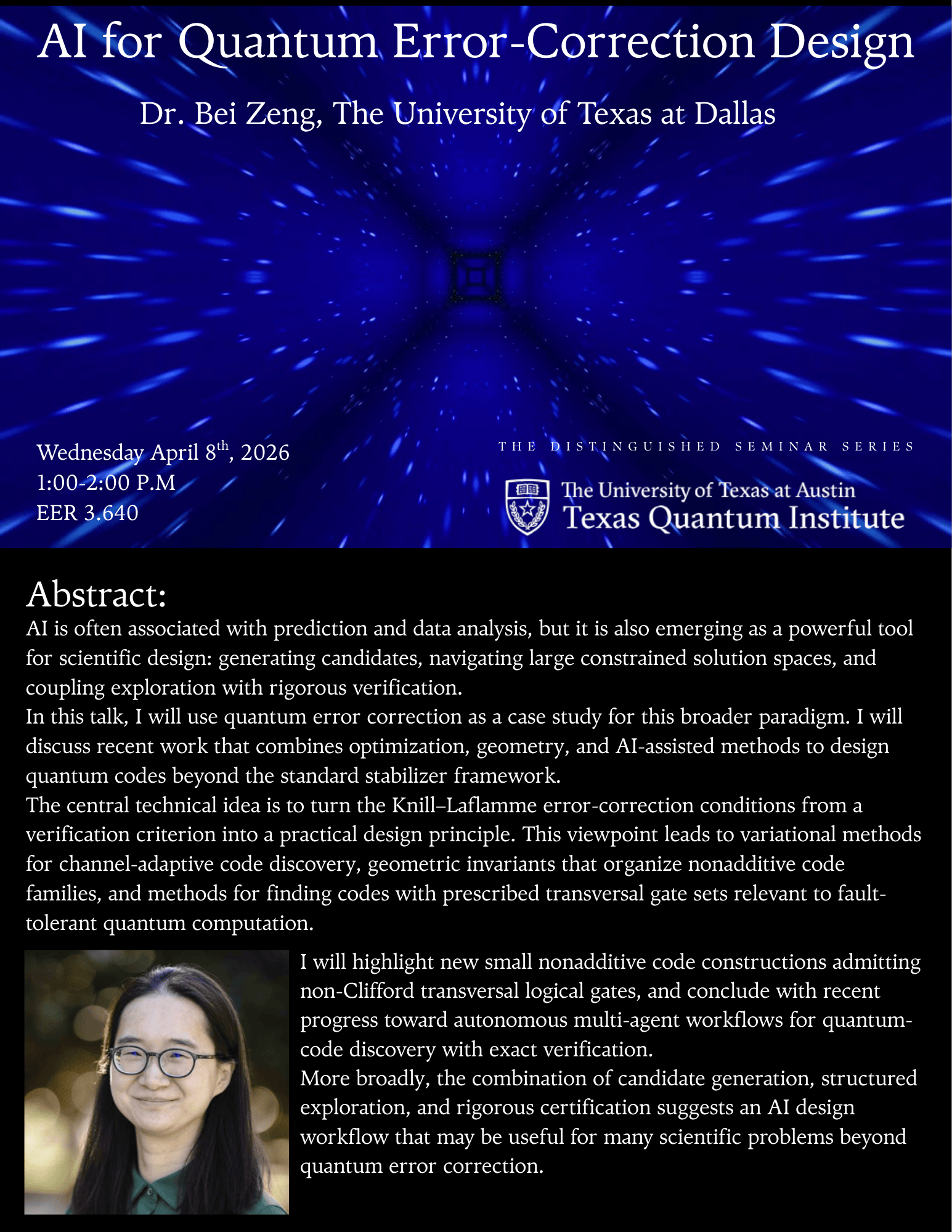
Distinguished Seminar Series: "AI for Quantum Error-Correction Design" w/ Dr. Bei Zeng
1:00 pm - 2:00 pm
Location: Online
Speaker: Dr. Bei Zeng, The University of Texas at Dallas
Abstract: AI is often associated with prediction and data analysis, but it is also emerging as a powerful tool for scientific design: generating candidates, navigating large constrained solution spaces, and coupling exploration with rigorous verification. In this talk, I will use quantum error correction as a case study for this broader paradigm. I will discuss recent work that combines optimization, geometry, and AI-assisted methods to design quantum codes beyond the standard stabilizer framework. The central technical idea is to turn the Knill–Laflamme error-correction cond
itions from a verification criterion into a practical design principle. This viewpoint leads to variational methods for channel-adaptive code discovery, geometric invariants that organize nonadditive code families, and methods for finding codes with prescribed transversal gate sets relevant to fault-tolerant quantum computation. I will highlight new small nonadditive code constructions admitting non-Clifford transversal logical gates, and conclude with recent progress toward autonomous multi-agent workflows for quantum-code discovery with exact verification. More broadly, the combination of candidate generation, structured exploration, and rigorous certification suggests an AI design workflow that may be useful for many scientific problems beyond quantum error correction.
Date: Wednesday April 8th, 2026
Time: 1:00 - 2:00 P.M CST
Location: Online
Photos from The Talk:
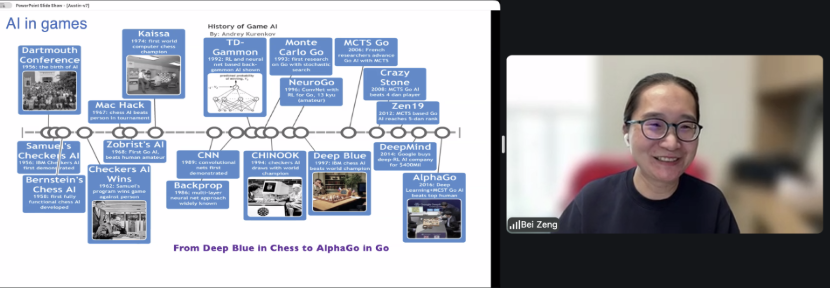
Dr. Zeng is discussing the history of AI in games throughout the years as it started with chess and checkers and has now evolved to something much more.
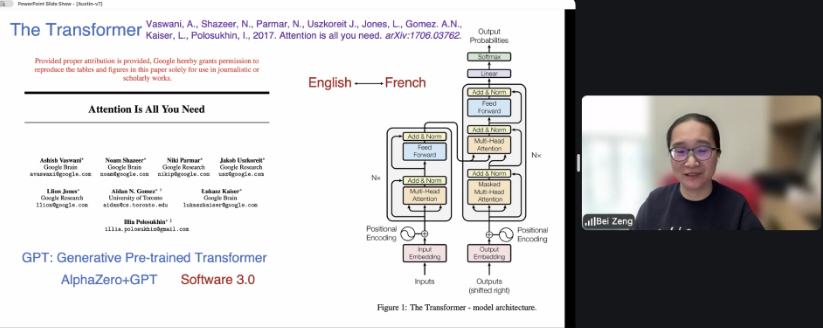
The architecture for language translation can be dictated by a Transformer - an AI tool. GPT actually stands for Generative Pre-trainied Transformer.
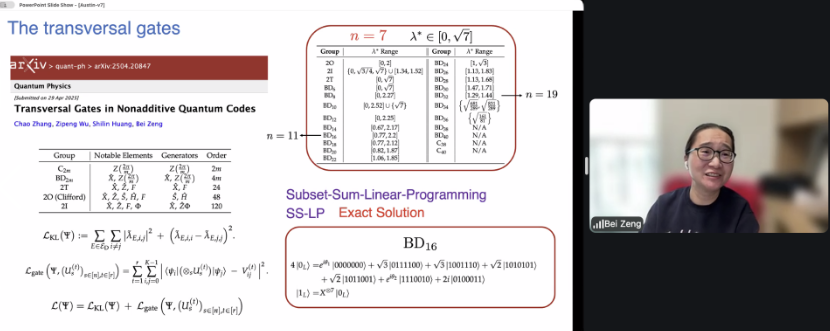
Transversal gates can be applied locally instead of globally to prevent errors from spreading. This practice is sometimes called a "transversal operation".